
What Is CDOC? Colorado Department of Corrections
The official state prison agency is the Colorado Department of Corrections, and the agency uses the public abbreviation CDOC on its own website. CDOC custody is not the same as a county jail booking. County sheriffs hold people after recent arrests, during pretrial detention, on local sentences, and on local or outside holds. CDOC holds people sentenced to Colorado Department of Corrections custody and manages state-prison placement, time computation, release processing, and parole or re-entry operations connected to that sentence.
The official Colorado Department of Corrections home page shows CDOC as the statewide agency entry point.
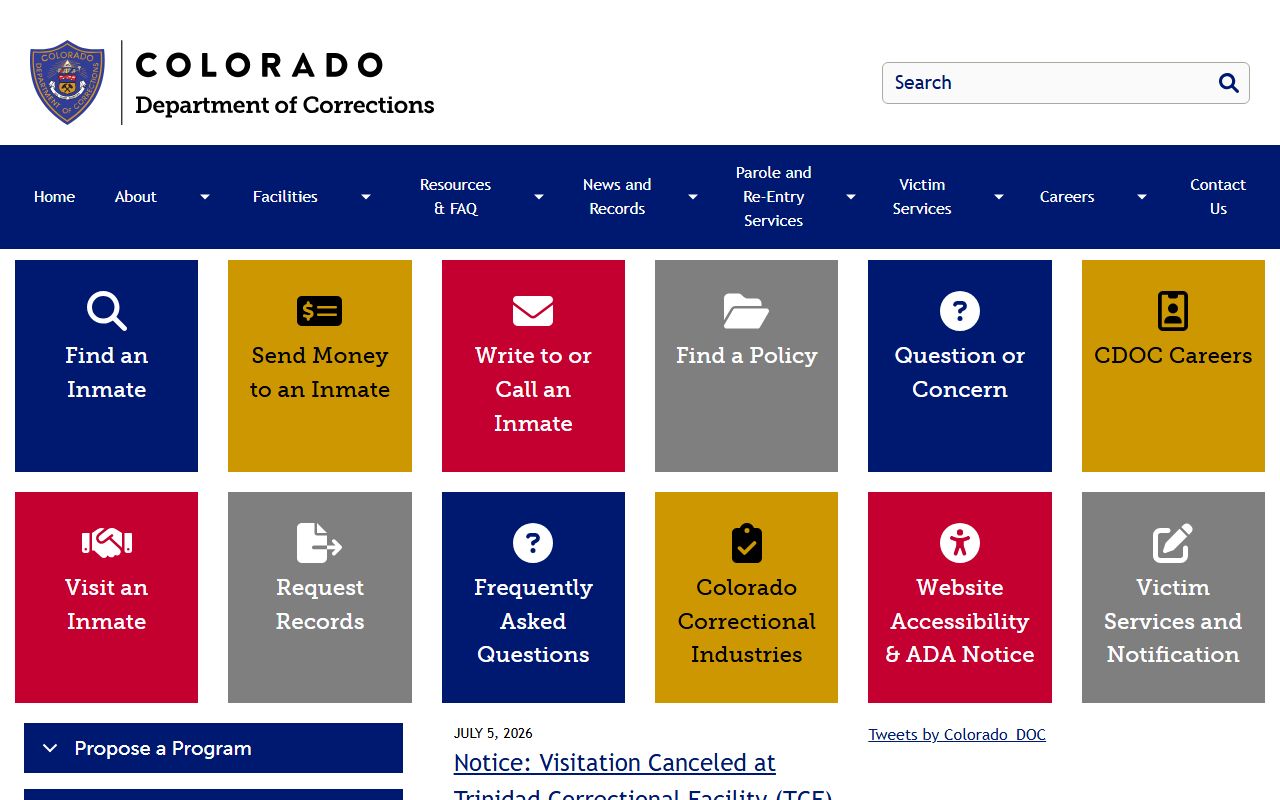
That source is why the page uses CDOC as the agency abbreviation and keeps state-prison custody separate from county jail custody.
The distinction controls where to search. A person arrested last night in Adams, Denver, Mesa, Weld, or another Colorado county is usually searched through that county's jail roster, booking report, phone route, or VINELink. A sentenced state prisoner belongs in the CDOC inmate population and is searched through the official CDOC Offender Search. Federal prisoners use the Bureau of Prisons locator, and ICE civil detainees use ICE ODLS.
The CDOC Inmate Population
CDOC's January 2026 Monthly Population and Capacity Report, as of January 31, 2026, reported 16,535 grand-total ADP populated beds against 16,961 operational capacity when adult and Youthful Offender System rows are combined. The same report identified 426 ADP vacant beds and a 2.51 percent ADP operational vacancy rate. CDOC also reported a separate external or non-prison inmate population total of 2,026, so the broader jurisdictional context is larger than the in-prison bed count alone.
CDOC links its population-report archive from the official statistics page.
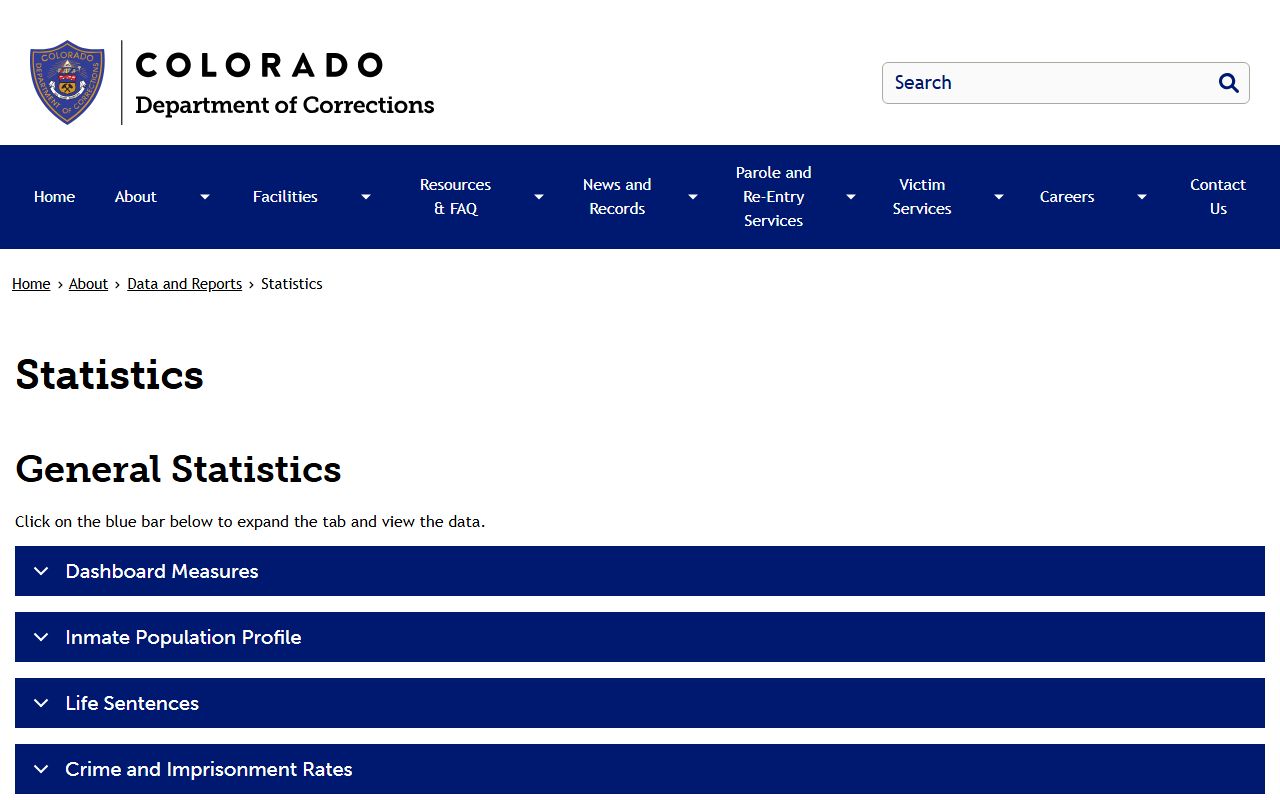
The statistics page is the statewide source behind the population, capacity, and trend figures summarized here.
| Measure | Figure | Source / Date |
|---|---|---|
| CDOC inmate population in populated beds | 16,535 ADP | CDOC Monthly Population and Capacity Report, Jan. 31, 2026 |
| Operational capacity | 16,961 | CDOC Monthly Population and Capacity Report, Jan. 31, 2026 |
| Vacant beds | 426 ADP | CDOC Monthly Population and Capacity Report, Jan. 31, 2026 |
| External / non-prison inmate population | 2,026 | CDOC Monthly Population and Capacity Report, Jan. 31, 2026 |
How to Search the CDOC Inmate Locator
The official CDOC inmate locator is the CDOC Offender Search. The visible form accepts DOCNO, last name, first name, and gender, with gender options for All, Male, and Female. The page also uses a CAPTCHA-style counting challenge before submission and links to New Search, Search Tips, Disclaimer, Accessibility, the Parole Board, and the Department of Corrections site.
The current CDOC Offender Search screenshot shows the public DOCNO, name, and gender fields.
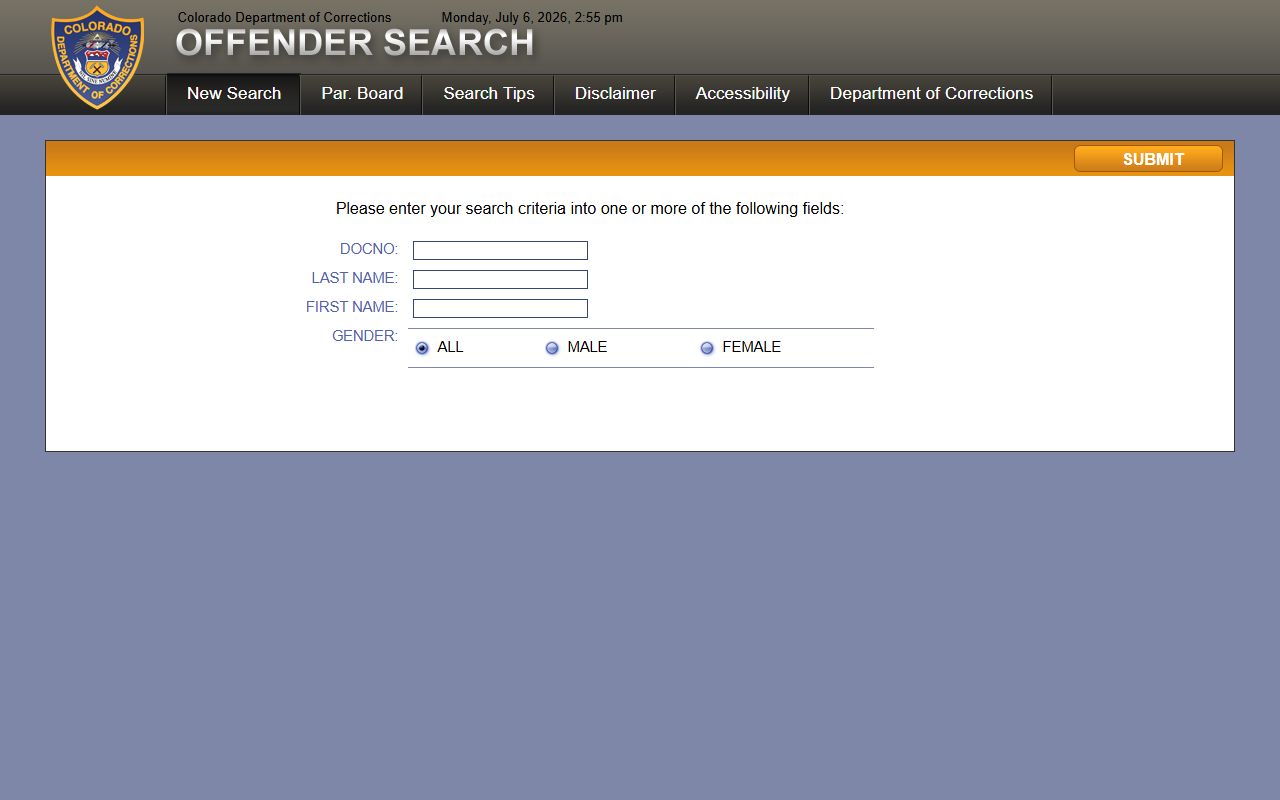
The form layout supports the search guidance below: use a DOC number when possible, then name fields if needed.
- Search by DOC number first if it is known; it is the most precise key.
- If the DOC number is not known, search by last name and first name, then try spelling variations if needed.
- Leave gender set to All unless the result set is too broad or the recorded gender field is known.
- Complete the counting challenge and review any result for identity, DOC number, status, facility, and release or parole information if displayed.
- If there is no result, check county jail custody, BOP federal custody, ICE detention, recent transfer timing, release status, or restricted-record conditions.
What a CDOC Inmate Record Can Show
The CDOC Offender Search is a state-prison lookup. It is not a county jail roster, mugshot gallery, warrant database, court docket, or police incident system. Public result details can help identify the person and custody path, but they do not replace county booking records, court filings, or agency records requests.
| Field | What It Means |
|---|---|
| DOCNO | The CDOC number used to identify the state-prison record. |
| Name | The name recorded by CDOC; spelling and name variations can affect searches. |
| Gender | A search filter on the public form, not a substitute for identity confirmation. |
| Facility or Status | The CDOC location or custody status if displayed by the current record. |
| Release / Parole Information | Public status details where CDOC displays them; final calculations are case-specific. |
CDOC Prisons and Facilities
The official CDOC facilities menu lists active state-run adult facilities, the Denver Complex, private prisons, Pueblo Campus facilities, and other CDOC pages. The system includes Arkansas Valley Correctional Facility, Buena Vista Correctional Complex, Delta Correctional Center, Limon Correctional Facility, Rifle Correctional Center, Sterling Correctional Facility, Trinidad Correctional Facility, the Canon City group, the Denver Complex, and the Pueblo Campus.
The statewide prison estate is shown on the official CDOC facilities page.
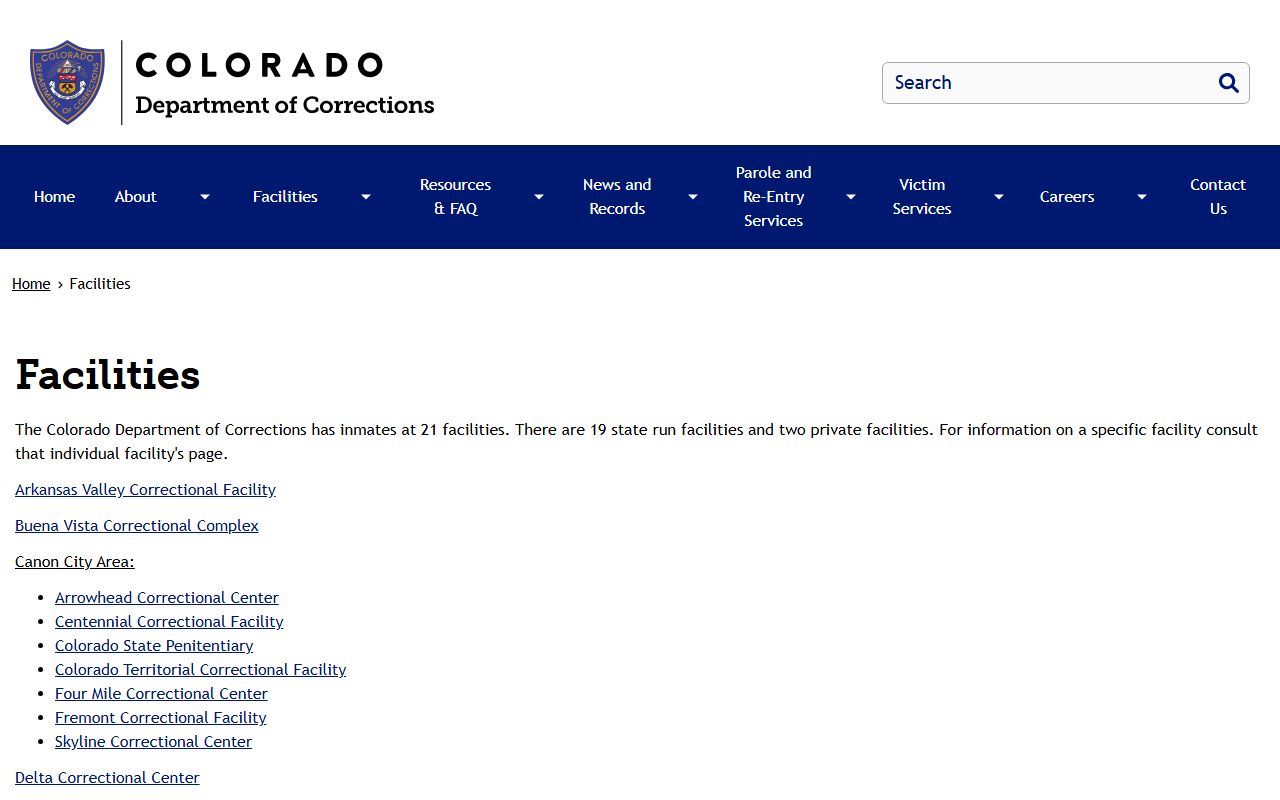
This facilities source is the reason the DOC page explains CDOC as a system instead of turning each prison into a separate apex page.
The Canon City group includes Arrowhead Correctional Center, Centennial Correctional Facility, Colorado State Penitentiary, Colorado Territorial Correctional Facility, Four Mile Correctional Center, Fremont Correctional Facility, and Skyline Correctional Center. The Denver Complex includes Denver Reception and Diagnostic Center and Denver Women's Correctional Facility. The private-prison submenu lists Bent County Correctional Facility and Crowley County Correctional Facility. The Pueblo Campus includes La Vista Correctional Facility, San Carlos Correctional Facility, and Youthful Offender System. The full statewide A-Z list is in the Facility Directory.
CDOC Intake, Classification, and Security Levels
CDOC says all inmates go through intake and classification at the Denver Complex. Male offenders go through Denver Reception and Diagnostic Center, and female offenders go through Denver Women's Correctional Facility. Intake includes criminal history, education, program needs, fingerprinting, photographing, DNA collection as required, and medical, mental-health, and dental evaluation. CDOC says the average intake and classification process takes three to six weeks.
CDOC documents that process on its official intake process page.
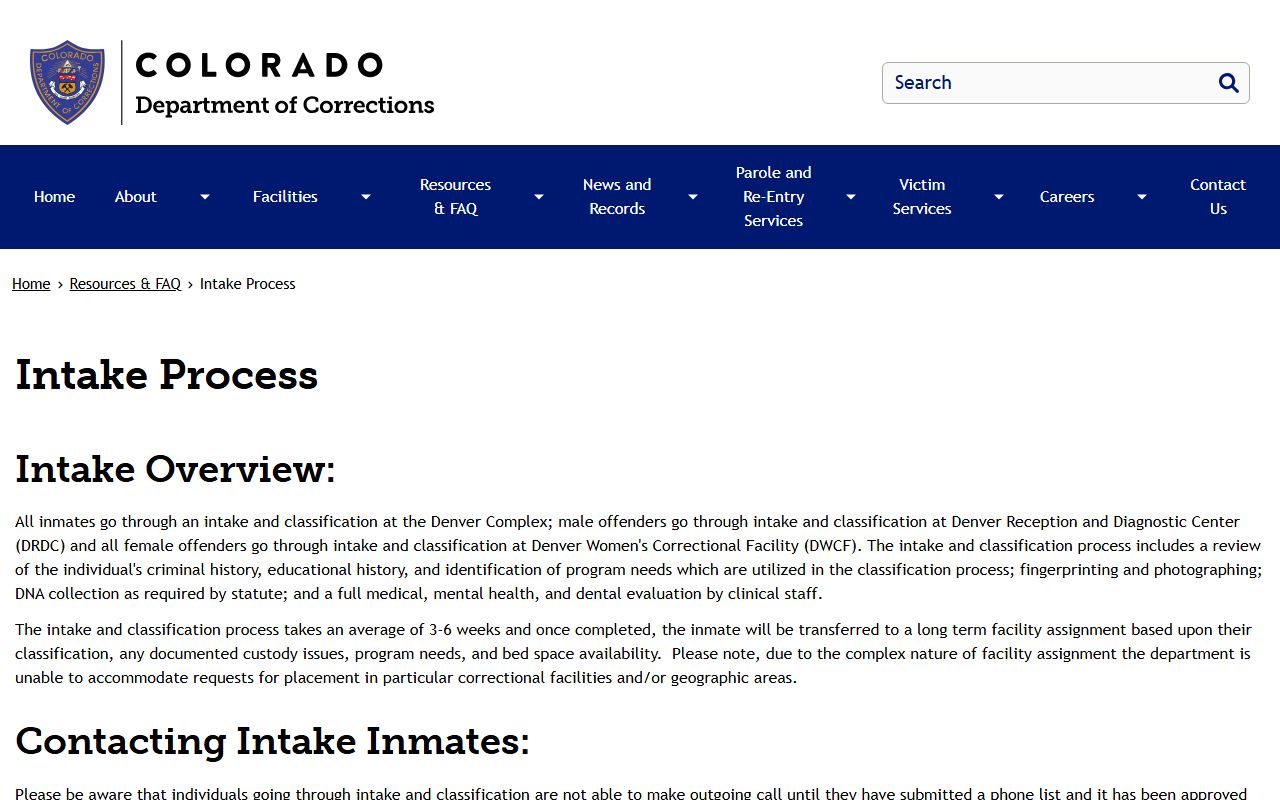
The intake page explains why a newly sentenced person may be in CDOC custody before a long-term facility assignment appears settled.
After intake, the long-term facility assignment depends on classification, documented custody issues, program needs, and bed space. CDOC says it cannot accommodate requests for a particular facility or geographic area. The January 2026 report uses security-level categories I through V and special-purpose categories such as clinical, program, restrictive-housing, infirmary, off-grounds, and other non-capacity or offline categories. Public explanations should treat security level as a high-level classification framework, not as a guarantee that every institution has one fixed population type.
CDOC Inmate Population Trends
CDOC's June 30, 2025 report listed State & Private Prison Total facility population of 15,826 and Total Inmate Jurisdictional Population of 17,890. The June 30, 2024 report listed State & Private Prison Total facility population of 15,774 and Total Inmate Jurisdictional Population of 17,489. From June 2024 to June 2025, facility population increased by 52 and jurisdictional population increased by 401. The January 2026 ADP format shows the in-prison ADP remaining above 16,000 when adult and YOS rows are combined.
| Date | Prison Facility Population / ADP | Jurisdictional Context |
|---|---|---|
| June 30, 2024 | 15,774 facility population | 17,489 total inmate jurisdictional population |
| June 30, 2025 | 15,826 facility population | 17,890 total inmate jurisdictional population |
| Jan. 31, 2026 | 16,535 grand-total ADP populated beds | 2,026 external / non-prison inmates reported separately |
Sentencing, Parole, and Release in CDOC Custody
The court imposes the sentence. County jail handles local custody until transfer. CDOC receives the person, classifies them, houses them, computes time under applicable law and policy, and manages prison or parole transition operations. The Colorado State Board of Parole is separate from CDOC and has sole authority to grant or deny discretionary parole to incarcerated people in CDOC custody.
Good time and earned time are statutory and case-specific. C.R.S. 17-22.5-301 is the good-time statute, and C.R.S. 17-22.5-405 is the earned-time statute. The current earned-time law allows earned time not to exceed ten days for each month of incarceration or parole for demonstrated consistent progress, with a higher not-to-exceed twelve-day category for certain lower-level felonies when statutory criteria are met. Actual release calculations depend on offense date, sentence type, jail credit, concurrent or consecutive sentences, parole-board action, disciplinary history, earned-time awards, and later court orders.
CDOC vs. County Jail: Where to Look
The CDOC inmate population is the state-prison side of Colorado custody. A county jail roster is the correct starting place for a recent arrest, a pretrial detainee, a local sentence, or a county hold. The CDOC inmate locator is the correct starting place after a person has entered Colorado Department of Corrections custody. Use the County Directory for the local jail side.
| CDOC State Prison | County Jail | |
|---|---|---|
| Who is held | People sentenced to Colorado Department of Corrections custody | Recent arrests, pretrial detainees, local sentences, warrants, and holds |
| Run by | Colorado Department of Corrections | County sheriff or local detention agency |
| Where to search | CDOC Offender Search | County Directory |
CDOC Records Requests
CDOC's CORA/CCJRA page states that CDOC is a criminal justice agency maintaining public records and criminal justice records. Requests are evaluated under C.R.S. 24-72-201 et seq. or C.R.S. 24-72-301 et seq. CDOC instructs requesters to email doc_open_records@state.co.us and include the requester's name, inmate name if applicable, inmate DOC number if applicable, inmate date of birth if applicable, media outlet if applicable, and a detailed description of the records requested.
The official CDOC CORA / CCJRA page is the source for the state-prison records request framework.
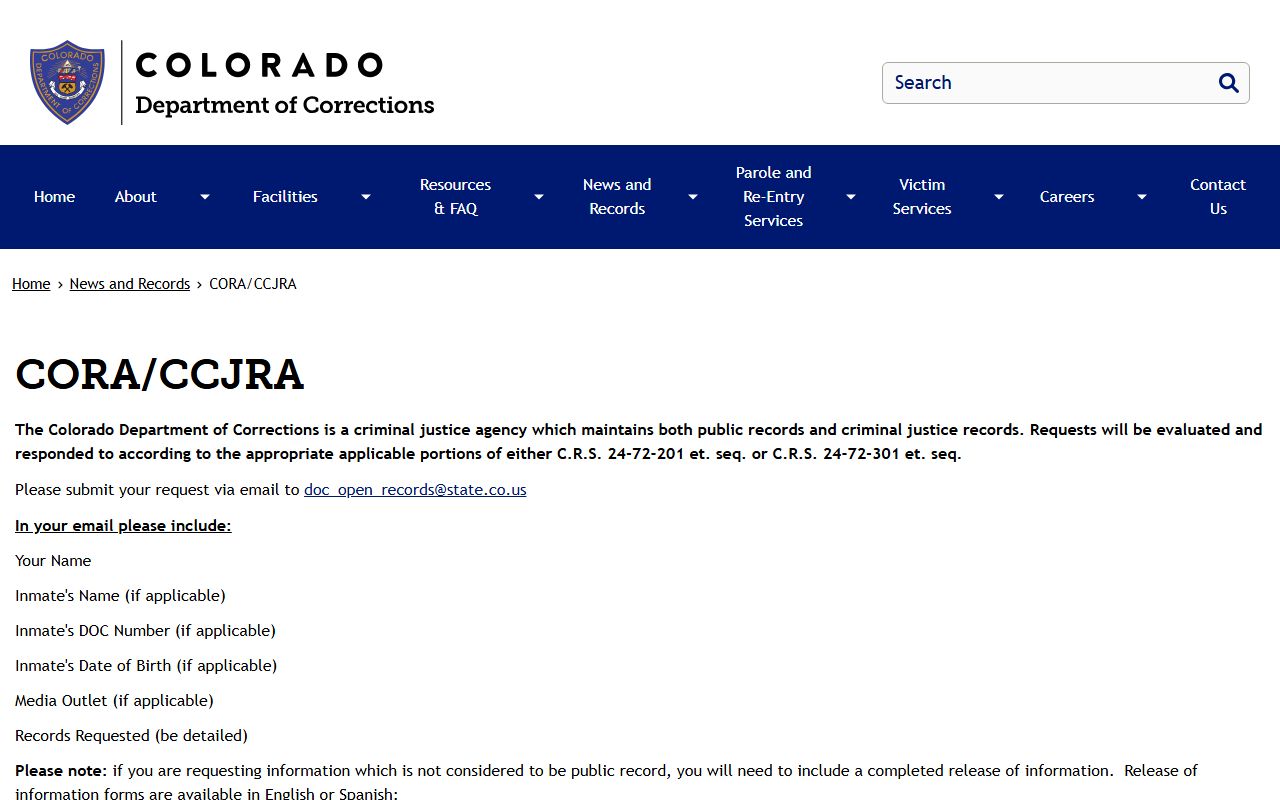
The screenshot ties the records-request instructions to CDOC's own public guidance rather than a county jail process.
CDOC's general records page says inmate departmental records should be requested by email to the open-records address and that departmental records do not include medical information. Medical and mental-health records follow the medical records request process. Requests that cite CORA, CCJRA, FOIA, or general open-records language for DOC records should be routed to DOC_open_records@state.co.us for tracking and routing.
CDOC Inmate Population FAQ
How big is the CDOC inmate population?
As of January 31, 2026, CDOC's monthly report showed 16,535 grand-total ADP populated beds against 16,961 operational capacity, plus a separate external or non-prison inmate population table totaling 2,026.
How do I search the CDOC inmate locator?
Use the official CDOC Offender Search. Search by DOCNO when possible, or use last name, first name, and gender. A no-result can mean the person is still in county jail, federal custody, ICE custody, recently transferred, released, or restricted from public display.
Does CDOC show county jail bookings?
No. County jail bookings are searched through the county sheriff, jail roster, booking report, phone route, or VINELink. CDOC is for sentenced state-prison custody and related CDOC statuses.
Public Record Search
Sponsored Results